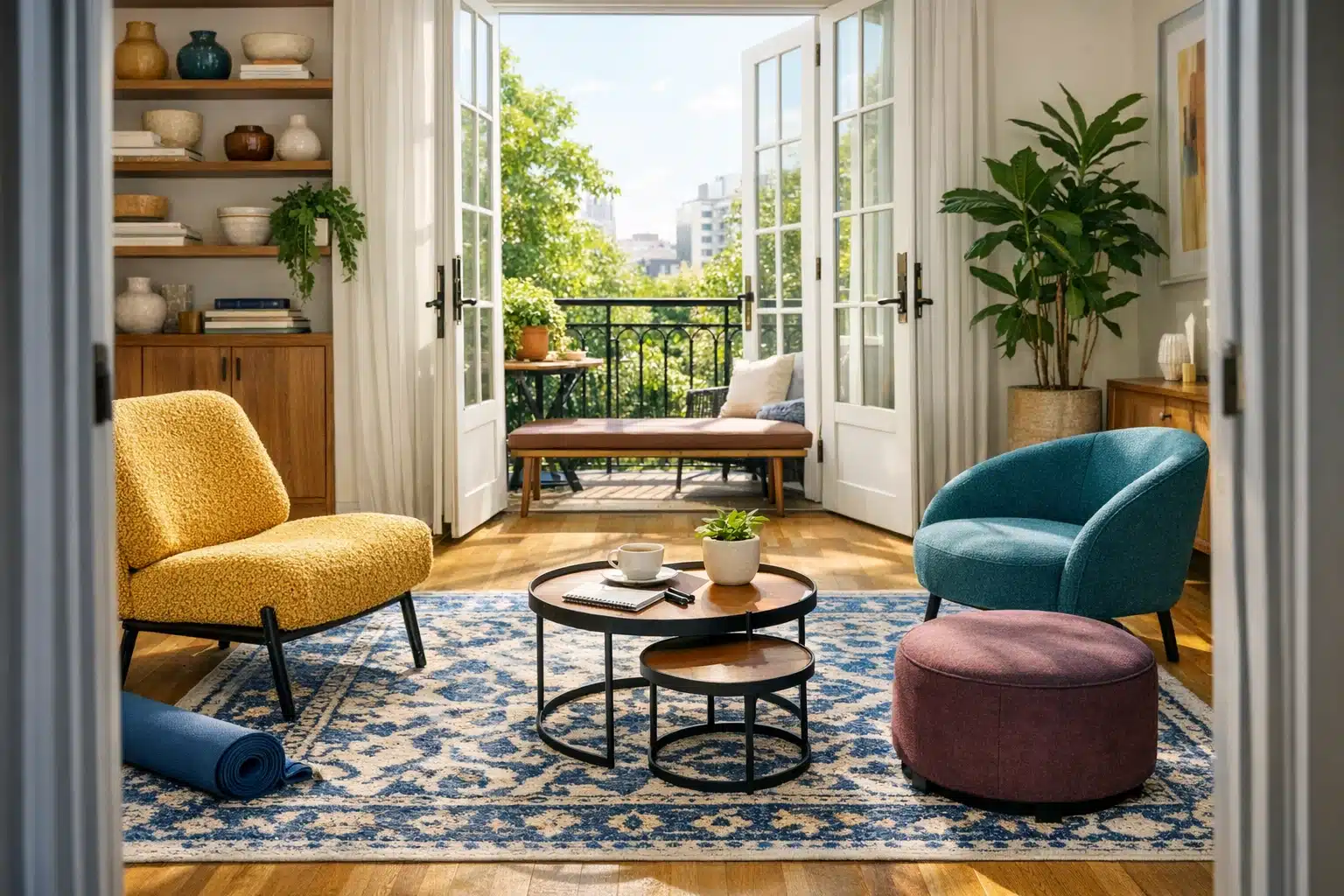
Living Room Without a Sofa? The New Trends for 2025 You’ll Love
In 2025, the living room is no longer a static display built around one oversized sofa. Homes now serve as work zones, reading corners, social hubs, and quiet retreats, often inside the same compact footprint. That shift is steering furniture choices toward lighter, more adaptable pieces that can move with the rhythm of the day. If your layout feels cramped or predictable, a sofa-free setup may offer more comfort, flexibility, and style than tradition suggests.
Outline
- Why the classic sofa is no longer the only logical centerpiece
- How changing routines are reshaping living room planning
- Which furniture combinations work best without a sofa
- Why small homes benefit most from lighter seating layouts
- How to build a conversation-friendly room that fits real life in 2025
1. Why the Classic Sofa Is Losing Its Monopoly
Чудили ли сте се дали диванът е незаменим? Днес интериорът се променя бързо. Все повече дизайнери го заменят с по-гъвкави и модерни решения.
For decades, the sofa was treated as the unquestioned anchor of the living room. It was large, central, and symbolic: if a room had a sofa, it felt complete. Yet design habits are rarely eternal. The living room of 2025 is being shaped less by tradition and more by daily behavior, especially in urban homes where every square meter matters. Instead of asking, “Where should the sofa go?” many people now start with a better question: “What does this room need to do?” That small change in thinking has opened the door to a much wider set of design solutions.
One reason for this shift is visual balance. A large sofa can dominate a room before any other element has a chance to speak. In contrast, a composition made from separate chairs, compact benches, or a daybed creates breathing space. The room feels layered rather than heavy. Designers often describe this as reducing visual mass: fewer bulky surfaces, more negative space, and clearer lines of sight. The result is a room that looks calmer, brighter, and often larger than it really is.
Another reason is lifestyle diversity. A household may include someone who reads every evening, someone who works remotely, a child who builds on the floor, and a guest who drops by for coffee. One big sofa can serve some of those needs, but not always all of them well. Separate seating pieces allow each zone to feel more intentional. A lounge chair can support posture better than a deep couch, while a low stool can double as a side table or extra seat when needed.
Several broader trends are also pushing the sofa out of its old throne:
- Smaller apartments make bulky furniture harder to justify.
- Flexible work habits require rooms to change function throughout the day.
- Interest in personal interiors has reduced reliance on one standard layout.
- Modular and movable furniture has become easier to find across price ranges.
There is also an emotional dimension. People want homes that reflect personality, not catalog formulas. A room with two sculptural chairs, a woven pouf, and a slim chaise can feel more collected and more honest than a predictable three-seat sofa facing a television. It tells a story about how the residents actually live. In that sense, removing the sofa is not a rejection of comfort. It is a shift toward purposeful comfort, where every piece earns its place.
2. Designing for Real Life: Work, Leisure, and Daily Movement
Начинът ни на живот вече е различен. Всекидневната не е само за почивка, а и за работа и хобита. Големият диван често заема твърде много място.
This idea captures one of the strongest forces behind the sofa-free living room: modern life is mixed-use. The same room may host a video call in the morning, a yoga session at noon, a board game after dinner, and a quiet hour with a book before bed. Traditional sofa-centered layouts were built for a narrower routine, often focused on passive sitting. In 2025, people increasingly want living rooms that support movement, posture changes, and different forms of attention.
Consider remote work. A deep, low sofa may feel relaxing for twenty minutes, but it is rarely ideal for laptop use, sketching, knitting, or writing notes. Armchairs with supportive backs, compact lounge chairs with an ottoman, or a bench near natural light can make a room more useful without turning it into an office. The best multiuse spaces are not crowded with furniture; they are planned around activities. That is why zoning has become such an important concept in interior design. Instead of one large seating block, homeowners create smaller functional pockets inside the room.
A practical layout might include:
- a reading chair with a floor lamp and a small side table,
- a pair of movable seats for conversation,
- a pouf or ottoman that works as footrest, table, or extra perch,
- an open patch of floor for stretching, play, or hobby work.
This kind of arrangement improves circulation too. You can walk through the room more easily, shift pieces when guests arrive, and adapt the layout without feeling trapped by one dominant object. In family homes, this matters even more. Parents may want open space for children’s activities without sacrificing comfort for adults. In shared apartments, movable seating allows each resident to shape the room differently at different times.
There is a subtle design advantage here as well: a room built for real life usually looks better because it feels believable. When furniture reflects use, the space gains rhythm and logic. A chair angled toward a window suggests reading. Two chairs facing each other invite conversation. A low bench by the wall can hold books, trays, or a bag dropped after work. These cues make the room feel alive.
The sofa is not disappearing because comfort no longer matters. It is being reconsidered because comfort has become more nuanced. Today, many people value supportive seating, flexible movement, and adaptable routines over a single oversized place to sink. That change is practical, but it is also deeply human.
3. The New Seating Mix: Armchairs, Poufs, Daybeds, and More
Хората искат повече стил и индивидуалност. Комбинации от кресла, пуфове и кушетки създават уникална атмосфера и по-голям комфорт у дома.
If the sofa is stepping aside, what takes its place? The answer is not one magical substitute but a curated mix of pieces with different strengths. That is exactly why these new layouts feel fresher: they are assembled, not prescribed. Instead of buying one large item that defines the entire room, homeowners can build seating like a playlist, combining comfort, proportion, color, and purpose.
Armchairs are often the first and best alternative. A good chair provides shape and support, and it can be chosen for upright reading, relaxed lounging, or occasional guest use. Compared with a sofa, two separate armchairs usually create more visual rhythm and improve face-to-face interaction. They also allow more freedom with fabrics, from boucle and linen to velvet and leather-like finishes, depending on the mood of the room.
Poufs and ottomans are the quiet heroes of flexible interiors. They can act as footrests, coffee table alternatives, casual seats, or movable accents. Because they are lightweight, they can be pulled into a conversation circle and then tucked away. Daybeds and chaise-style couches add another layer. They preserve the pleasure of stretching out, but with a sleeker footprint than many traditional sofas. In studio apartments or guest-friendly homes, a daybed can bridge the gap between lounge furniture and occasional sleeping space.
Some of the most useful non-sofa options include:
-
Accent chairs for posture and visual character
-
Poufs for flexibility and soft texture
-
Benches for narrow walls and transitional seating
-
Daybeds or chaise lounges for reclining without bulk
-
Floor cushions for informal, relaxed gatherings
The success of this approach depends on balance. Mixing too many unrelated pieces can make the room feel accidental, while choosing items with shared tones, materials, or proportions creates harmony. For example, two wooden-framed chairs, a neutral pouf, and a low upholstered chaise can feel cohesive even when each piece has a different role. Repeating one color across textiles or one material across legs and tables helps tie everything together.
This is also where personality enters the room. A sofa often acts like a visual wall. A collection of lighter pieces behaves more like a conversation. It leaves room for art, rugs, bookshelves, sculptural lighting, and the little details that make a home feel lived in rather than staged. In 2025, people are not only buying furniture; they are composing experiences. A sofa-free arrangement gives them more notes to work with, and that creative freedom is part of the appeal.
4. Small Spaces, Big Relief: Why Lighter Furniture Works Better
Малките жилища изискват практичност. По-леките мебели създават простор и лесно се местят. Така пространството остава функционално и удобно.
This may be the most persuasive argument of all. In compact homes, every decision has spatial consequences. A deep sofa can eat up wall length, reduce walking paths, block light, and leave little room for anything else. In contrast, lighter furniture pieces allow the eye to travel across the room, which makes the space feel more open. Even when the actual floor area does not change, perception matters. A room that looks easier to navigate also feels easier to live in.
Interior designers often rely on a few simple tricks in smaller living rooms. They choose furniture with visible legs, avoid overly thick arms, and keep the center of the room flexible rather than fixed. A pair of slender chairs, for instance, can deliver the same seating capacity as a small sofa while preserving a clearer pathway. Add a nesting table or a compact ottoman with storage, and the room suddenly performs several functions without appearing packed.
Lighter furniture also makes daily maintenance less annoying. Pieces that can be shifted quickly are easier to clean around, easier to rearrange for guests, and easier to adapt when needs change. For renters, this matters a great deal. Large sofas are hard to move up staircases, awkward in elevators, and not always worth transporting from one apartment to another. A more modular setup travels better and ages more gracefully with different floor plans.
When planning a small sofa-free living room, it helps to prioritize the following:
- clear walking routes between entry, window, and adjoining spaces,
- multiuse furniture that can change role when needed,
- open sightlines that preserve light and reduce visual clutter,
- pieces scaled to the room rather than chosen by habit.
There is a psychological benefit too. A cramped room can make people feel mentally crowded, even when the décor is attractive. More open floor area often creates a sense of calm and control. You can breathe easier in a room that does not seem to press inward from every side. That is why many people who remove a sofa do not describe the result as merely stylish. They describe it as liberating.
Small spaces reward clarity. The less a room is forced to revolve around one bulky object, the more intelligently it can respond to real needs. In 2025, practical design is no longer seen as a compromise. It is a form of sophistication, and lighter living room furniture expresses that idea perfectly.
5. Conversation-Friendly Layouts and a Smart Plan for 2025
Новите подредби насърчават общуването. Креслата създават уютни зони за разговор. Домът става по-гъвкав, стилен и съобразен с модерния начин на живот.
One of the most interesting things about sofa-free living rooms is how social they can feel. A standard sofa layout often points everyone in one direction, usually toward a screen. By contrast, chairs arranged in pairs or small clusters naturally encourage eye contact. The room begins to support conversation instead of just co-viewing. This does not mean televisions must disappear, only that they no longer need to dictate every furniture decision.
A more conversational layout can be created with surprising ease. Two armchairs angled inward, a pouf in the middle, and a side table beside each seat can form a welcoming zone that feels intimate without being formal. Add a bench near a wall or window, and the room gains extra seating without losing openness. If you enjoy hosting, this arrangement is especially useful because guests can join the group without awkwardly perching at the edge of one long couch.
For anyone curious about trying the trend, a full redesign is not always necessary. Start by identifying your most common living room activities. Then ask which of them truly require a sofa and which might work better with other pieces. Many people discover that they need one excellent reading chair, one flexible extra seat, and a practical surface more than they need a large upholstered block.
A smart plan for 2025 usually follows these steps:
- Measure the room and mark circulation paths before buying anything.
- Choose a primary function, such as reading, hosting, or mixed daily use.
- Select two or three seating types with different strengths.
- Use rugs, lighting, and side tables to define zones.
- Leave enough empty space so the room can change with the day.
Conclusion for Homeowners and Renters Ready for Change
If you have been feeling that your living room is too crowded, too predictable, or simply not aligned with the way you live now, this trend is worth serious attention. A sofa-free layout is not a rule, and it is certainly not a requirement for good design. It is an invitation to think more clearly about function, mood, and movement. For homeowners, it can refresh a tired room without following a formula. For renters, it offers adaptability and easier mobility. For anyone wanting a space that feels personal, current, and genuinely useful, 2025’s new living room ideas offer something better than novelty: they offer fit.